
781,000 Days: What Happens After a Patient Is Ready to Go Home
By Catherine Krepkikh, DPT
Ready to Go, Still Here
In July 2026, the Florida Hospital Association released numbers that have stayed with me. Between July 2024 and June 2025, 243,000 patients remained in Florida hospitals after they were medically cleared to leave.¹ Those delays added up to 781,000 unnecessary hospital days and $2.5 billion in preventable spending.¹ That is capacity hospitals had already paid for, staffed and couldn't use, while patients waited in the ED for a bed upstairs. Here's where those hours go, what they cost patients, and which ones leaders can take back.
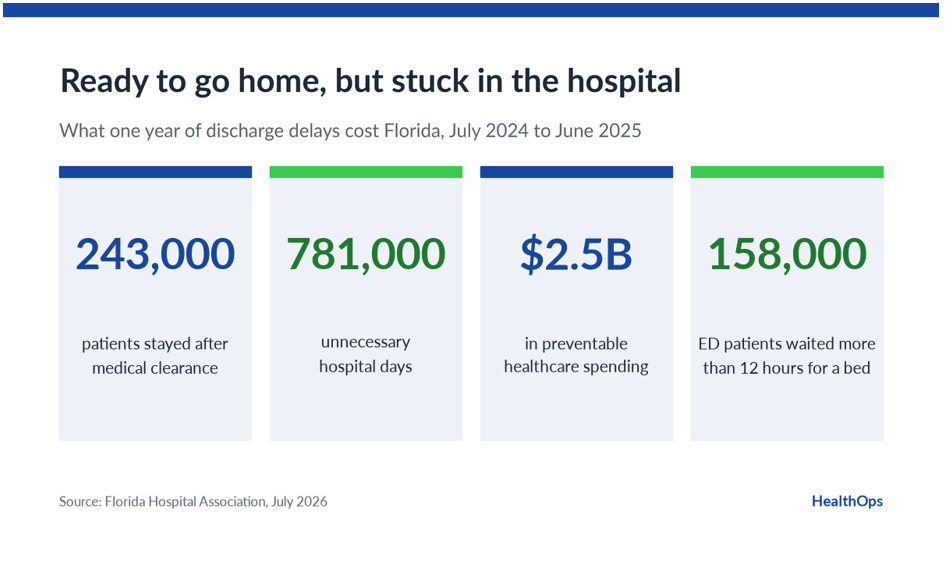
Source: Florida Hospital Association, July 2026
The key words are "medically cleared." For each of these patients, the clinical work was done. What was missing was the next step.
A discharge order closes the clinical chapter of a stay. Everything after it depends on rides, rooms, approvals and placements lining up on time, and that is where these patients got stuck.
What One Extra Day Costs a Patient
In more than two decades as a physical therapist, I never thought of a hospital day as neutral. Every day in bed takes something from a patient's strength, and the research supports that.
When healthy older adults stayed on bed rest for ten days, they lost almost a kilogram of lean tissue from their legs and about 16% of their knee strength.³ Across studies, about 30% of hospitalized older adults go home with a new disability in basic daily activities.²
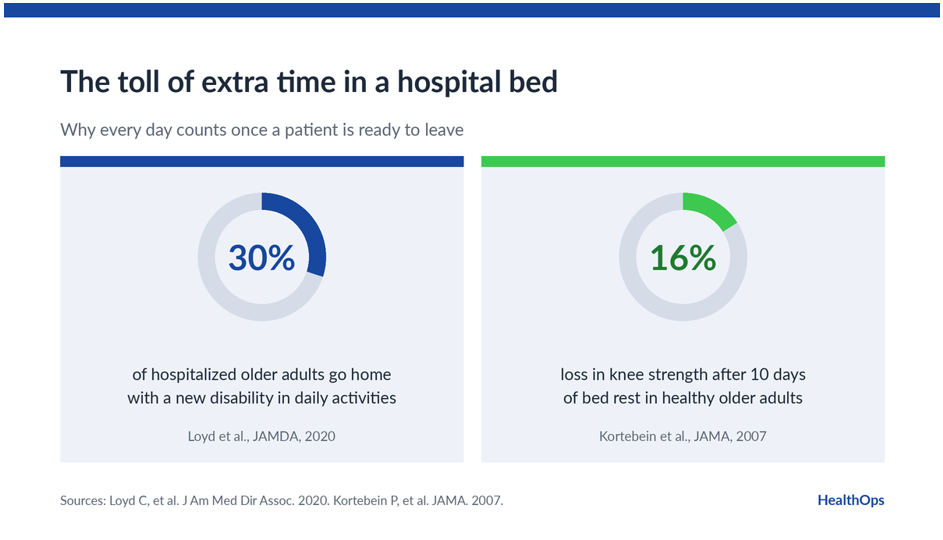
Loyd C, et al. J Am Med Dir Assoc. 2020. Kortebein P, et al. JAMA. 2007.
So an extra day after a patient is ready to leave isn't just a capacity problem. It can mean a harder recovery for the patient, and more work for the family who brings them home.
The Bed Upstream Is Someone Else's Wait
Patient flow is a chain. When one patient can't leave, another can't come up from the emergency department.
The same Florida report found that 158,000 ED patients, or 7.4%, waited more than 12 hours for an inpatient bed.¹ Many of those waits began with a delay somewhere else in the building or somewhere outside of it.
Where the Delays Begin
Some of the biggest barriers sit outside hospital walls:
41% of delayed patients were waiting for their health plan to authorize follow up care.¹
41% were waiting for a bed in a skilled nursing or rehabilitation facility.¹
Almost half of delayed patients were covered by Medicare Advantage, and 52% of their delays were tied to prior authorization.¹
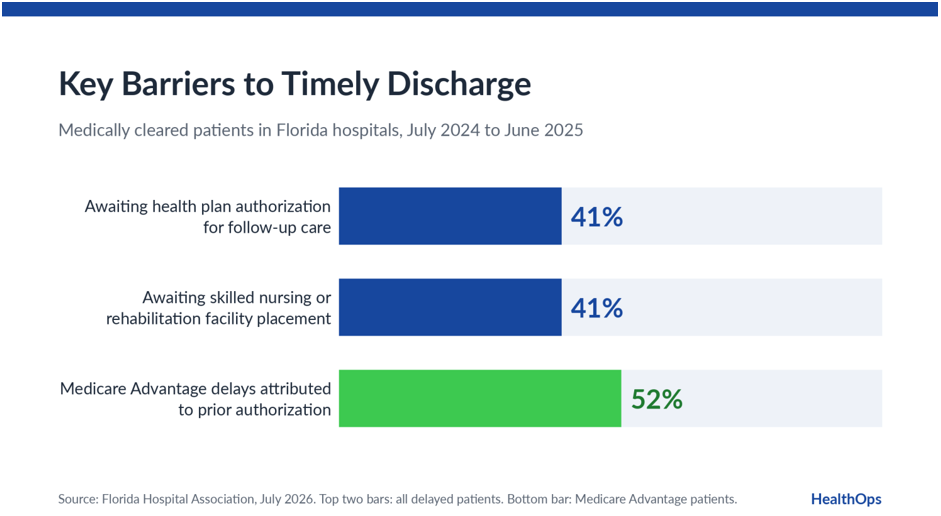
Policy and Payer Barriers to Timely Discharge in Florida hospitals, from July 2024 to June 2025
These truly are policy and payer issues, and they deserve attention at that level. They also remind us how much a discharge depends on many hands working in sequence.
The Hours Leaders Can Control
Inside the hospital, every discharge is a relay. The order is written. The family is called. Transport arrives. The room is cleaned and turned. The right equipment is ready for the next patient.
Each handoff is small, but together they decide whether a bed opens at 11 in the morning or 6 at night.
The teams behind those handoffs, including patient transport, environmental services and equipment management, have a direct influence on how quickly a hospital can care for its next patient. When they're coordinated, visible and reliable, clinical teams can do what they do best.
Closing the Gap Between Ready and Home
A patient cleared at 9:00 in the morning shouldn't still be in that bed at 9:00 at night. The hours in between are operational, which means hospitals can measure them, own them and shorten them.
For the hospital leaders here, I'd love to hear from you. What is one handoff in your organization that would open beds sooner if it moved faster?
About the Author
Catherine Krepkikh DPT, is the Senior Growth Strategist at HealthOps, leading data-driven research and growth while contributing thought leadership in hospital operations, compliance, and strategic outsourcing.
References
Florida Hospital Association. FHA survey finds delays in post-hospital care slow patient recovery, increase healthcare costs. Published July 15, 2026. https://www.fha.org/FHA/FHA/News-Content/New-Releases/FHA_Survey_Finds_Delays_Post-Hospital_CareSlow_Patient_RecoveryIncrease_Healthcare_Costs.aspx
Loyd C, Markland AD, Zhang Y, et al. Prevalence of hospital-associated disability in older adults: a meta-analysis. J Am Med Dir Assoc. 2020;21(4):455–461.e5. https://pmc.ncbi.nlm.nih.gov/articles/PMC7469431/
Kortebein P, Ferrando A, Lombeida J, Wolfe R, Evans WJ. Effect of 10 days of bed rest on skeletal muscle in healthy older adults. JAMA. 2007;297(16):1772–1774. https://jamanetwork.com/journals/jama/article-abstract/206740