
by Catherine Krepkikh
Most studies that make headlines say yes. This one said no, and I think it may be one of the most useful studies hospital leaders read this year.
In October, the journal Anesthesiology published the ORACLE trial, led by Daniel Sessler, MD, and colleagues.¹ The team enrolled 110,538 surgeries across 68 operating rooms and analyzed 107,334 of them.¹ The question was simple: if you add air purification to an operating room, do fewer patients get infections?
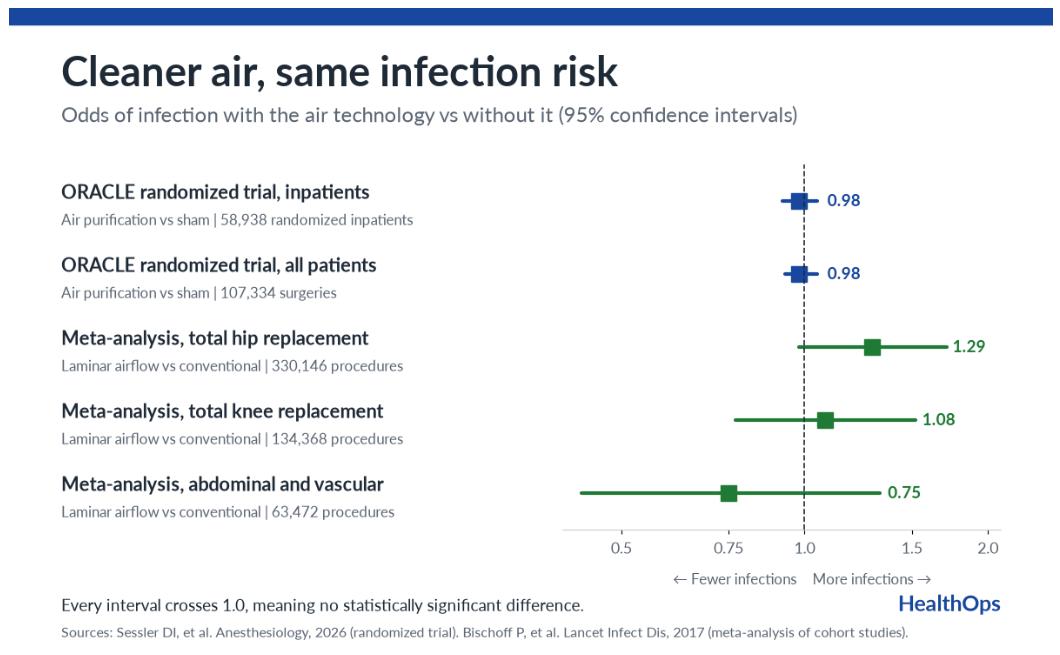
The answer was no. Among inpatients, wound infection, infection related complications or death within 30 days occurred in 8.1% of patients during active purification and 8.2% during sham purification.¹ Across all patients, the numbers were 5.5% and 5.6%.¹
Why This Result Is Hard to Argue With
What makes this study stand out is how it was built.
Each operating room was randomized in four week blocks to either an active unit or an identical looking sham.¹ Patients, clinicians and investigators were all blinded.¹ The devices were added on top of each room's routine air filtration, so the trial tested whether extra purification adds value in a modern operating room.²
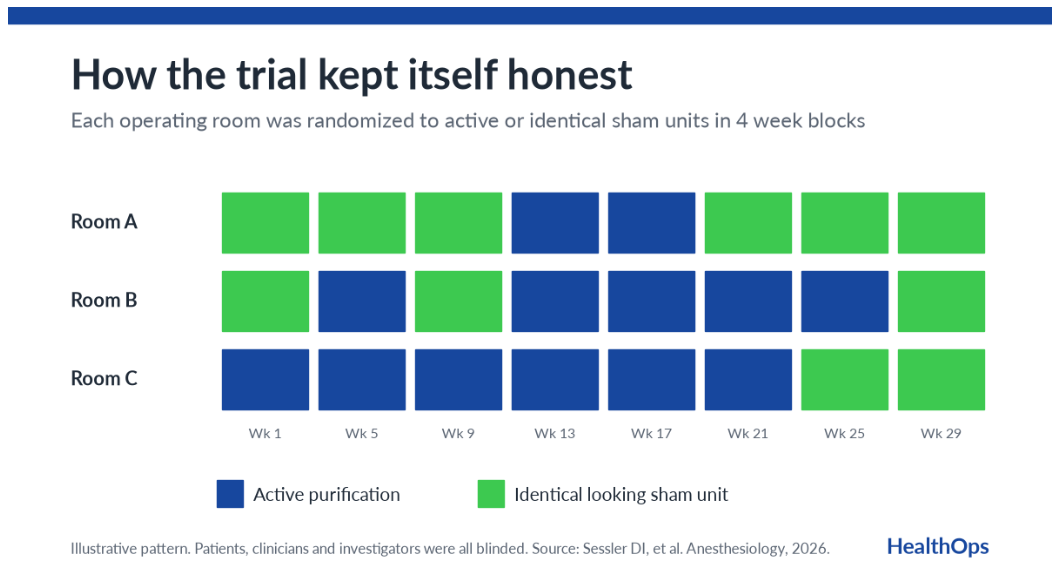
Because every room took turns with real and sham units, each room served as its own comparison. Enrollment stopped early at the third interim analysis, when the results crossed the trial's futility boundary, meaning more enrollment was unlikely to change the answer.¹ The odds ratio for the primary outcome was 0.98, with a 95% confidence interval of 0.92 to 1.05.¹
One more detail I respect: the trial was supported by a grant from ActivePure, and the authors report that the funder was not involved in data collection, analysis or writing of the manuscript.¹ A clear no, published anyway, is what good science looks like.
This Isn't the First Time Air Said No
As a clinician, I'm cautious about any single study, even a large one. So I looked at whether ORACLE fits with what came before it. It does.
ORACLE tested supplemental purification units. An earlier body of research tested a different air technology, laminar airflow ventilation, which pushes filtered air in a steady stream over the surgical field. The underlying question was the same: does cleaner operating room air mean fewer surgical infections?
A systematic review and meta-analysis in The Lancet Infectious Diseases pooled 12 observational studies on this question.⁴ It found no reduction in deep infections after hip replacement (330,146 procedures) or knee replacement (134,368 procedures), and no reduction in infections after abdominal and open vascular surgery (63,472 procedures).⁴
Earlier, an Annals of Surgery study used German national surveillance data covering 99,230 operations in 63 surgical departments.⁵ Laminar airflow showed no protective effect, and it was associated with a higher risk of severe infection after hip replacement.⁵
Based on this evidence, the World Health Organization's global guidelines suggest that laminar airflow systems should not be used to reduce infection risk in total joint replacement.⁶ WHO labels this a conditional recommendation based on low to very low quality evidence.⁶
Where the Debate Still Lives
To be fair, not everyone agrees. The German Society of Hospital Hygiene has argued that many of the observational studies behind the laminar airflow findings have methodological limits and cannot settle the question.⁷ That critique is reasonable for studies that weren't randomized.
That's exactly why ORACLE matters. It's a randomized, blinded trial in more than 100,000 surgeries, and it points in the same direction as the observational research.¹ ⁴ It also has limits. It tested one supplemental technology in operating rooms that already had ventilation in place.² It doesn't tell us about patient units, intensive care units or poorly ventilated spaces, and it shouldn't be stretched that far.
Where Infections Actually Start
If air isn't the main driver, what is? CDC's guideline on surgical site infection notes that for most of these infections, the source of the bacteria is the patient's own skin, mucous membranes or organs.³ Outside sources still matter, including the surgical team, the operating room environment and everything brought to the sterile field.³
The ORACLE authors reached a similar conclusion: infection prevention efforts might better focus on limiting direct wound contamination.¹ That puts the spotlight back on fundamentals, the processes people perform and someone can check.
Measure the Basics You Already Own
Here's where this connects to the work of operations and support services leaders.
When hospitals measure the fundamentals, the fundamentals improve. In a study of 36 US acute care hospitals published in Infection Control and Hospital Epidemiology, researchers marked room surfaces with a fluorescent marker to check whether they were cleaned after terminal cleaning.⁸ At baseline, only 48% of more than 20,000 targeted surfaces were cleaned.⁸ After education, process changes and objective feedback to environmental services staff, that rose to 77%.⁸
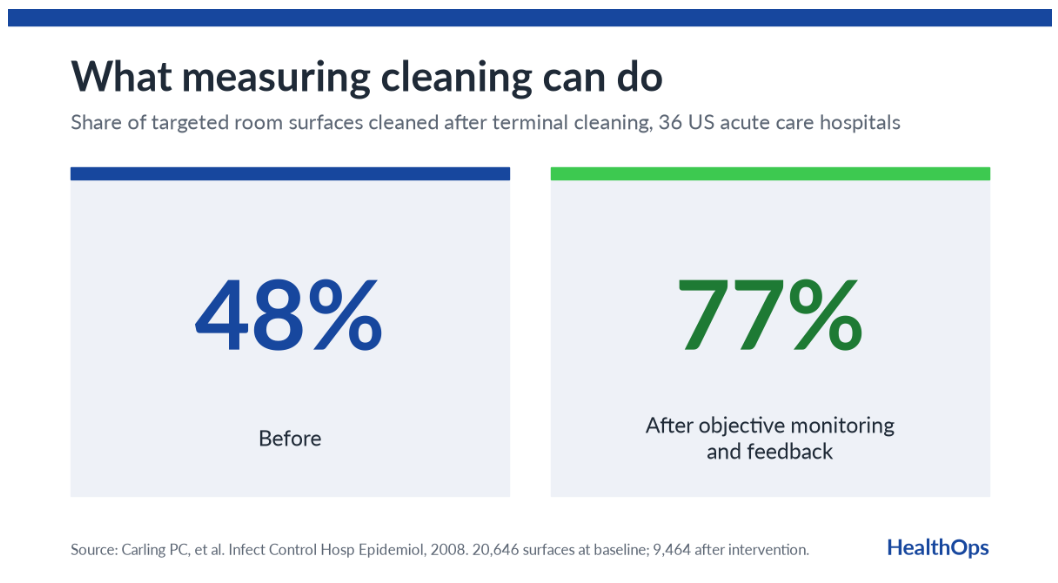
That study measured cleaning thoroughness, not infection rates, and it was in patient rooms, not operating rooms. I share it for a different reason. The authors found the gains were achievable without a substantial added financial commitment, through monitoring, feedback and leadership support.⁸ It's a reminder that a lot of improvement comes from making existing work visible.
Questions Before the Next Purchase
Whenever a new technology promises to reduce infections, I'd encourage leaders to ask a few questions before signing:
•What outcome evidence exists? Lab results or reduced bacterial counts are not the same as fewer patient infections.
•Was it tested against a sham or a true comparison, and was anyone blinded?
•Was it tested in a setting like ours?
•How will we measure whether it works here, and what will we stop doing if it doesn't?
•Are the basics we already pay for being done well, and how do we know?
None of this means technology has no place. It means the burden of proof belongs to the purchase, not to the patient.
The Value of a Clear No
In more than two decades as a physical therapist, I learned that the most valuable test is often the one that rules something out. It saves time, money and attention for what actually helps.
ORACLE did that for operating room air. For hospital leaders, the lesson reaches beyond surgery: test before you fund, and keep investing in the work you can see and measure.
What's one purchase your team would want to see tested before you commit to it?
About the Author
Catherine Krepkikh DPT, is the Senior Growth Strategist at HealthOps, leading data-driven research and growth while contributing thought leadership in hospital operations, compliance, and strategic outsourcing.
References
1. Sessler DI, Mascha EJ, Ekrami E, et al. Operating room air filtration-sterilization and surgical infections: the ORACLE randomized trial in 110,538 surgeries. Anesthesiology. Published online October 19, 2026. doi:10.1097/ALN.0000000000006424. https://pubmed.ncbi.nlm.nih.gov/42896234/
2. ClinicalTrials.gov. Operating Room Air Filtration/Sterilization (ORACLE). NCT04610294. https://clinicaltrials.gov/study/NCT04610294
3. Mangram AJ, Horan TC, Pearson ML, Silver LC, Jarvis WR; Hospital Infection Control Practices Advisory Committee. Guideline for prevention of surgical site infection, 1999. Infect Control Hosp Epidemiol. 1999;20(4):250–278. https://pubmed.ncbi.nlm.nih.gov/10219875/
4. Bischoff P, Kubilay NZ, Allegranzi B, Egger M, Gastmeier P. Effect of laminar airflow ventilation on surgical site infections: a systematic review and meta-analysis. Lancet Infect Dis. 2017;17(5):553–561. https://pubmed.ncbi.nlm.nih.gov/28216243/
5. Brandt C, Hott U, Sohr D, Daschner F, Gastmeier P, Rüden H. Operating room ventilation with laminar airflow shows no protective effect on the surgical site infection rate in orthopedic and abdominal surgery. Ann Surg. 2008;248(5):695–700. https://pubmed.ncbi.nlm.nih.gov/18948793/
6. World Health Organization. Global Guidelines for the Prevention of Surgical Site Infection. 2nd ed. Geneva: WHO; 2018. https://www.who.int/publications/i/item/9789241550475
7. Popp W, Alefelder C, Bauer S, et al. Air quality in the operating room: surgical site infections, HVAC systems and discipline. Position paper of the German Society of Hospital Hygiene (DGKH). GMS Hyg Infect Control. 2019;14:Doc20. https://pmc.ncbi.nlm.nih.gov/articles/PMC6997799/
8. Carling PC, Parry MM, Rupp ME, et al. Improving cleaning of the environment surrounding patients in 36 acute care hospitals. Infect Control Hosp Epidemiol. 2008;29(11):1035–1041. https://doi.org/10.1086/591940