By Kyle Gibbons, Certified Hospital Surveyor & Healthcare Compliance & Auditing Manager
Choosing an accrediting body is a pivotal strategic decision for healthcare leadership, even though all four major entities share CMS “Deemed Status” and ensure compliance with Medicare’s Conditions of Participation (CoPs). Beyond this shared regulatory baseline, these organizations differ fundamentally in their operational philosophies and in the logistical burden they place on hospital staff.
The four accrediting organizations discussed here are:
The Joint Commission (TJC)
Det Norske Veritas (DNV)
Accreditation Commission for Health Care (ACHC)
Center for Improvement in Healthcare Quality (CIHQ)
When evaluating these organizations, leadership should balance high-level branding goals against available administrative bandwidth.
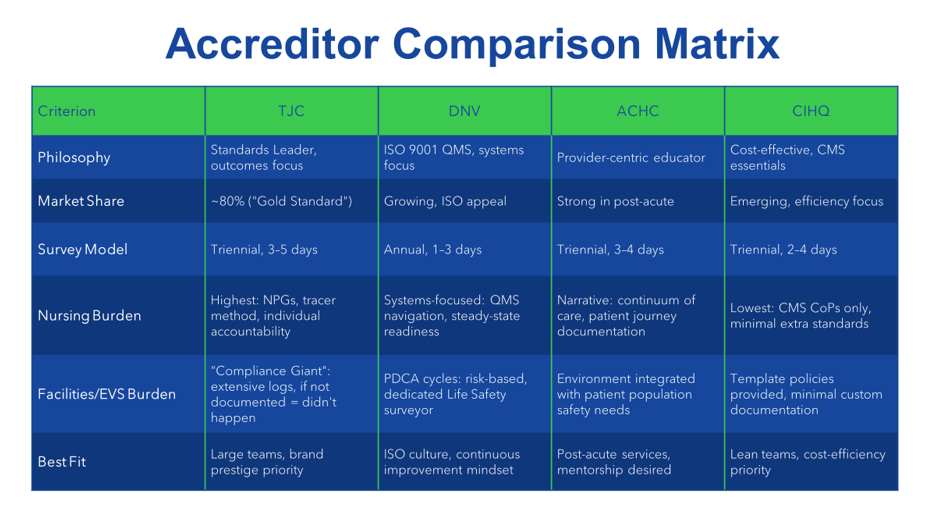
Table breaking down the 4 accrediting bodies
TJC: Standards and Prestige
The Joint Commission remains the most recognized name in hospital accreditation, and that brand strength is a meaningful part of its appeal. For many leadership teams, choosing TJC is not simply a compliance decision but also a signal to the market that the organization wants to align itself with the accreditor most closely associated with rigor, visibility, and the traditional “gold standard” of hospital oversight. Its approach is rooted in clinical outcomes and patient safety, and that orientation often translates into expectations that extend beyond baseline CMS compliance, particularly through the prominence of National Performance Goals and a survey process designed to test how reliably those standards are lived at the point of care.
Operationally, TJC follows a triennial survey model, but few organizations experience it as a once-every-three-years event. In practice, its 3- to 5-day surveys create a long shadow across the organization, driving cycles of readiness activity, internal audits, leadership rounding, policy review, and documentation reinforcement well before surveyors arrive. For hospitals with the infrastructure to support that level of preparation, the model can sharpen discipline and reinforce organizational accountability; for leaner teams, it can also create a significant administrative surge that competes with day-to-day operational priorities.
For nursing leaders, the TJC model is often where the intensity becomes most tangible. The survey process places a premium on precision, consistency, and individual accountability, asking nurses not only to deliver safe care but also to demonstrate, often in real time, that every critical step was documented exactly as expected. Through tracer activity and chart-level scrutiny, the experience can feel less like a broad systems review and more like a close examination of whether frontline practice holds up under a microscope, especially in areas such as reassessments, titration documentation, timestamps, and required signatures.
That same dynamic extends into Facilities and Environmental Services, where TJC’s expectations around the physical environment can create one of the heaviest compliance lifts in the accreditation landscape. Life Safety and Environment of Care documentation must be exceptionally well organized, current, and defensible, because the standard is not simply whether the work was done, but whether it can be proven without ambiguity. For support service leaders, that means the survey burden is often less about any single inspection day and more about sustaining a documentation culture strong enough to withstand a high-stakes, detail-oriented review.
Best Fit
Hospitals with large, mature quality and compliance teams.
Organizations that place a premium on reputation, external credibility, and alignment with the most recognized accreditation brand in the market.
Leadership teams willing to accept a heavier documentation and readiness burden in exchange
DNV: ISO-Based Process Auditor
DNV tends to resonate with organizations that are ready to treat accreditation as a management system, not just an inspection event. Its philosophy is grounded in ISO 9001 principles, which means the spotlight shifts from isolated findings to the integrity of the Quality Management System itself how policies are designed, how failures are detected, and how reliably they are corrected over time. For leadership teams that are already leaning into continuous improvement and “Just Culture” thinking, DNV’s model often feels less like an external audit and more like a structured framework for the work they want to be doing anyway.
The operational cadence reinforces that mindset. Instead of a high-stakes triennial visit, DNV surveyors are on-site every year for a shorter, 1–3 day review, which nudges the organization toward steady-state readiness rather than periodic sprints. For nursing, the emphasis is less on memorizing prescriptive requirements and more on being able to walk surveyors through how the system works: where policies live, how staff escalate concerns, how near-misses are reported, and how leaders close the loop. Facilities and EVS leaders see a similar shift; with a dedicated Life Safety specialist often present for the full survey, the conversation centers on PDCA cycles, risk mitigation, and evidence that corrective actions are actually sustained instead of treated as one-time fixes.
Best Fit
Hospitals ready to embed ISO 9001 or similar QMS principles into daily practice.
Organizations that prefer continuous, collaborative audits and a Just Culture focus on systems rather than individuals.
Teams comfortable maintaining a constant state of readiness for shorter, annual visits.
ACHC: The Provider-Centric Educator
ACHC is often the best fit for leadership teams that want their accreditor to behave more like a partner in care delivery than a regulatory referee. Its model is intentionally provider-centric and education-heavy, with surveyors who are positioned less as inspectors and more as peer consultants focused on helping teams strengthen their practice over time. That makes ACHC particularly appealing to hospitals where Post-Acute, rehab, or specialty services are central to the strategy, because its brand and expertise are already well established in those parts of the continuum.
While ACHC still operates on a familiar triennial cycle, the experience at the front line feels different. Nursing teams are asked to tell the story of the patient’s journey, how the plan of care evolves, how handoffs occur, how families are engaged rather than simply defend a series of discrete documentation points. Facilities and EVS are viewed through a similarly holistic lens: the physical environment is evaluated not in isolation, but in terms of how well it supports specific patient populations, from ligature risk in behavioral health to accessibility and comfort for medically complex patients. For leaders who value coaching, narrative documentation, and collaborative problem solving, ACHC’s approach can feel like oxygen in a space that often defaults to “gotcha” oversight.
Best Fit
Hospitals with substantial Post-Acute or specialty service lines.
Organizations seeking a mentoring relationship and high educational support from surveyors.
Teams that value narrative, patient-journey documentation and collaborative review.
CIHQ: Cost-Effective Essentialist
CIHQ is designed for hospitals that want accreditation to be clear, efficient, and tightly aligned with what CMS actually requires without a lot of extra proprietary layering on top. Its standards track closely with the Conditions of Participation and CMS interpretive guidelines, adding only targeted requirements where there are genuine patient-safety gaps. For leadership teams managing tight administrative bandwidth, that “essentialist” philosophy can be a significant advantage: less time spent deciphering gray areas, and more time spent executing against well-defined expectations.
Operationally, CIHQ follows a triennial survey model with a 2–4 day on-site visit, but the burden profile looks different from more prescriptive accrediting bodies. Nursing teams are spared the need to maintain a separate, complex accreditor rulebook and can instead concentrate their energy on clean, defensible CMS compliance. Facilities and EVS leaders often feel the difference most acutely; CIHQ provides a robust library of templates, tools, and “roadmaps” that allow support services to stand up and maintain a solid compliance framework without building everything from scratch. For lean organizations, that combination of clarity, resource support, and lower documentation volume can turn accreditation from a chronic drain into a manageable, predictable obligation.
Best Fit
Lean organizations with constrained quality, nursing leadership, or Facilities/EVS administrative capacity.
Hospitals seeking the most cost-effective path to deemed status with high clarity and minimal extra documentation.
Teams that want to keep nurses at the bedside and facilities staff in the field rather than buried in policy creation.
Cross-Cutting Tools for Leadership
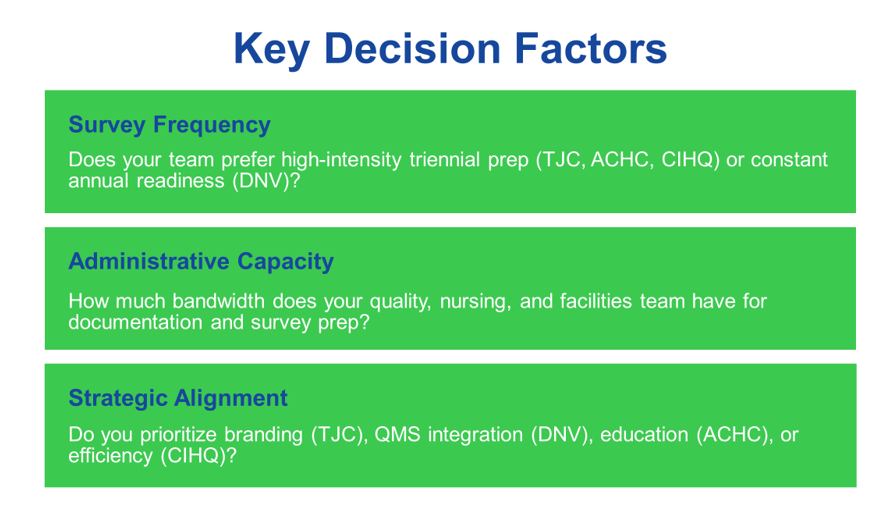
Use the tools below to align an accreditor with your hospital’s bandwidth, philosophy, and strategic goals.
Survey Frequency & Duration Readiness
The "Timing Difference" is the most significant logistical hurdle. Determine if your team prefers high-intensity bursts or steady-state maintenance.
Do you prefer high-intensity bursts every three years (TJC, ACHC, CIHQ) or steady-state readiness with annual 1–3 day surveys (DNV)?
Can your staff tolerate shorter, more frequent interruptions (annual) better than a single week-long deep dive (triennial)?
Does your budget and operations team have the capacity to manage the logistics of an on-site survey team every year?
Quality Management Maturity & Philosophy
Your choice should align with your hospital's "Core Philosophy" to ensure the accreditation process feels like a tool rather than a burden.
ISO 9001 Interest: Does your hospital have the bandwidth to integrate and maintain an ISO 9001 quality management system alongside standard healthcare regulations (DNV focus)?
Need for Clarity: Is your team currently struggling with "gray areas" in regulations? If so, does your bandwidth favor a partner known for "High Clarity" and "Regulatory Efficiency" (CIHQ)?
Educational Needs: Do you require an accreditor that provides significant "Educational Support" and a "Provider-Centric" approach during the survey process (ACHC)?
Outcome vs. Process: Does your team prefer to be measured on "Outcomes & Safety" (TJC) or through a "Process Audit" of your daily workflows (DNV)?
Strategic Resource Allocation
HealthOps recommends weighing your branding goals against your actual administrative capacity.
Branding vs. Effort: Is the "prestige" of the "Standards Leader" (TJC) worth the administrative bandwidth required for their comprehensive 3–5 day triennial survey?
Specialized Service Focus: Does a significant portion of your bandwidth go toward Post-Acute services, making ACHC a more strategically aligned partner
Cost-Effectiveness: Is your primary goal to find the most "Cost-Effective" route to compliance to free up bandwidth for other internal initiatives (CIHQ)?
Strategic Summary for Leadership
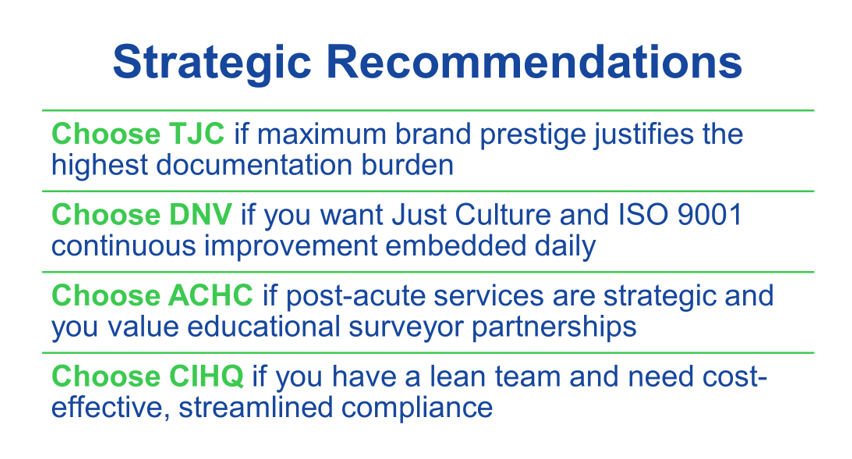
Quick final breakdown
About the Author
Kyle Gibbons, CHS is a Certified Hospital Surveyor who brings deep healthcare compliance expertise to HealthOps. He specializes in translating complex regulations into clear, practical standards that align policy with everyday clinical and operational practice.