
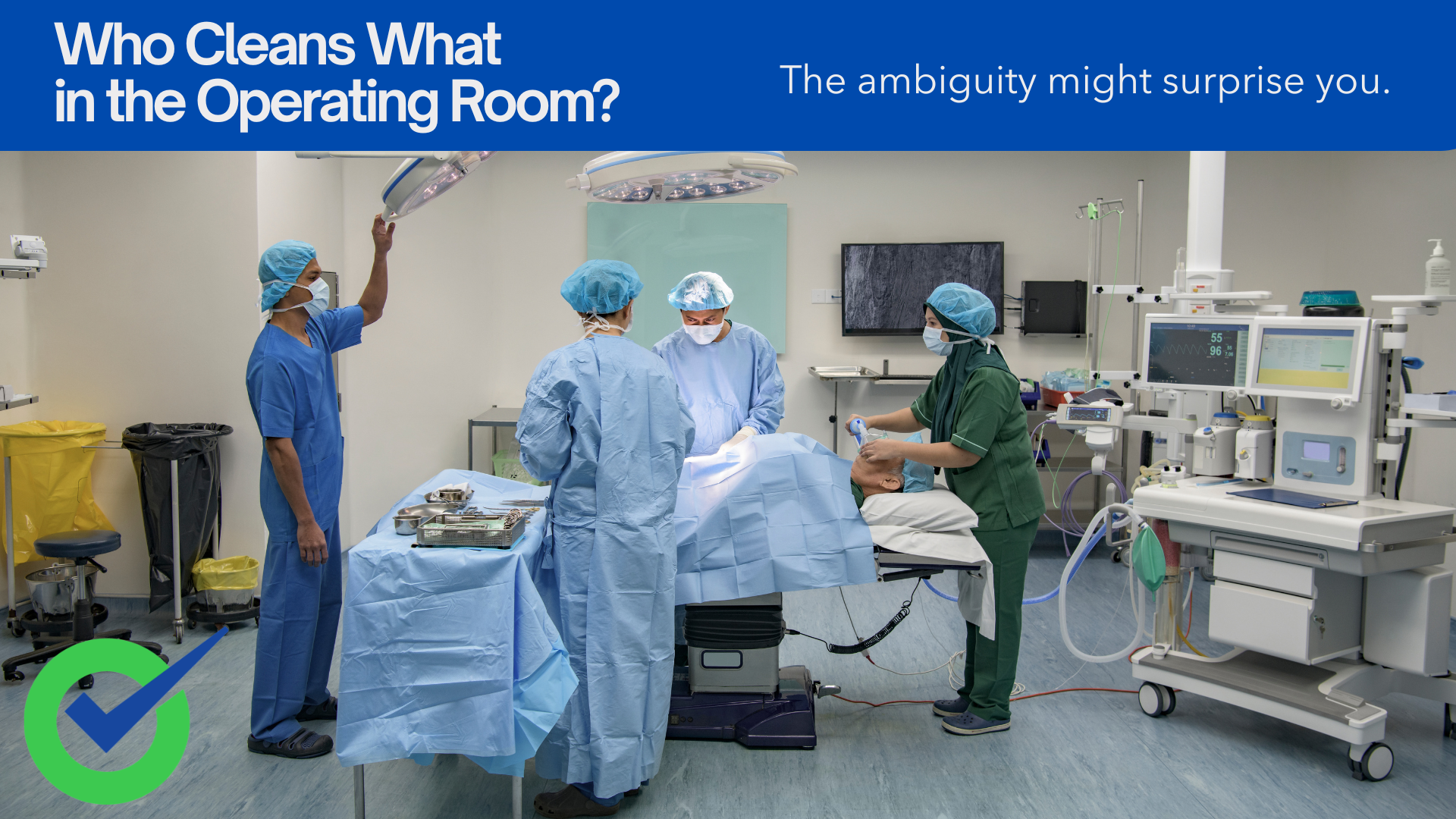
Who Cleans What in Your Operating Room? The Ambiguity might surprise you.
Who Really Cleans the OR Between Cases?
A 2020 national survey of 250 U.S. operating room directors, cited by Ecolab, found that between-case OR cleaning was most often carried out by OR clinical staff rather than EVS teams alone: 62% of between-case cleaning was completed by OR clinical staff, 19% by a hybrid model combining OR clinical staff and environmental services (EVS), and 19% by EVS alone.(1) That finding is not a current census of U.S. hospitals, but it remains the clearest quantitative snapshot publicly available on who owns this work, and it raises a question that is even more relevant in 2026: are hospitals treating OR turnover cleaning as a structured infection-prevention process with defined accountability, or as an informal task absorbed by whoever is available? (1,7)
Why this still matters in 2026
There is not a newer national, OR-specific dataset that cleanly replaces the 2020 survey’s staffing breakdown, so it should be presented as a baseline snapshot rather than as a definitive statement about every hospital today.(1) Even so, the direction of more recent evidence is consistent: AORN’s updated environmental hygiene guidance, CDC environmental cleaning guidance, and infection-prevention literature all place greater emphasis on clearly defined roles, competency-based training, adherence to disinfectant instructions for use, and objective monitoring of cleaning performance. (2,3,5,6,7)
That means the industry conversation has not moved away from the concern raised by the survey; if anything, it has moved further toward structured, EVS-inclusive, measurable cleaning programs. (2,7,8) For hospital leaders, EVS leaders, and infection prevention teams, the practical question is no longer simply who touches the room between cases, but whether the process is standardized, validated, and integrated into the hospital’s broader HAI prevention strategy. (2,3,5,7)
The infection-prevention stakes
Between-case OR cleaning is not just a throughput step. It is a frontline infection-prevention control point in an environment where surface contamination, workflow pressure, and inconsistent role ownership can all contribute to risk. (2,3,7,8) The Ecolab article that reported the 62/19/19 survey findings also cited research showing that only 25% of high-touch OR objects were cleaned under standard methods alone, and that cleaning improved when organizations used monitoring and feedback. (1)
That concern is reinforced by broader infection-prevention evidence. WHO reports that about 1 in 10 patients globally is affected by a healthcare-associated infection, and that strong infection prevention and control programs can reduce HAIs and antimicrobial resistance by 35% to 70%.4 CDC also continues to frame environmental cleaning as a core intervention for preventing transfer of microorganisms in healthcare settings.(3) In other words, ownership of OR turnover cleaning is not an operational footnote; it sits squarely inside the larger HAI prevention agenda. (3,4,5)
What newer guidance emphasizes
AORN: role clarity and team-based ownership
AORN’s 2026 environmental hygiene guidance and related commentary emphasize that OR cleaning should be designed and sustained by a multidisciplinary team that includes perioperative leadership, EVS, infection prevention, and quality stakeholders. (7) Recent AORN guidance also stresses visible “who cleans what” role definitions, attention to high-touch surfaces, use of clean wipes or cloths for each room or bay, and adherence to disinfectant contact times and other instructions for use. (2,7)
This is important because it shifts the discussion away from simplistic EVS-versus-clinical debates. AORN’s direction is not that only one department matters; it is that responsibilities must be explicit, evidence-based, and operationalized in a way that prevents missed surfaces and inconsistent technique. (2,7)
CDC and infection-prevention literature: standardization and validation
CDC’s environmental cleaning guidance underscores the need for facility-approved disinfectants, proper technique, and consistent cleaning processes to reduce transmission risk.(3) More recent literature on sustaining improvements in surface cleaning shows that gains are maintained through formal protocols, staff education, and ongoing audit-and-feedback systems rather than through informal expectations alone. (5)
Independent observation studies also show that cleaning compliance can look very different depending on who measures it, which is one reason objective validation matters.(6) For leaders, that has a direct implication: if a hospital cannot clearly demonstrate who is responsible for OR turnover cleaning, how those individuals are trained, and how performance is monitored, it is difficult to claim that the process is fully under control. (2,5,6)
What has not changed enough
A persistent challenge across healthcare is that cleaning duties often remain blurred between clinical staff and EVS teams. (9,10) More recent commentary still describes tension around whether certain cleaning tasks belong to nursing, ancillary staff, or EVS, especially in high-pressure operational environments. (9) This ongoing ambiguity is part of what keeps the 2020 survey relevant: even if the exact percentages have shifted, the underlying issue of unclear ownership has not disappeared. (1,7,9)
This is why the most credible use of the 2020 survey is not as a timeless statistic, but as a marker of a broader operational pattern that newer guidance continues to address. (1,7) The professional direction since then has been toward stronger EVS integration, clearer role matrices, and better monitoring; not toward looser or more informal cleaning models. (2,7,8)
What hospital leaders should take away
The lesson is not that every hospital must move to an EVS-only model for between-case OR cleaning. (7) The stronger conclusion is that any staffing model-- whether EVS-led, clinical-led, or hybrid-- must be backed by three things: clear ownership, competency-based training, and objective performance monitoring. (2,3,5,7)
For hospitals focused on reducing HAIs, improving survey readiness, and tightening high-risk workflows, the more relevant question is whether the current turnover model is defensible. Can leadership show exactly who cleans what between cases, how those staff are educated, whether disinfectant instructions are followed, and how cleaning thoroughness is validated over time? (2,3,6,7) In 2026, that is the standard hospital leaders should be measuring against.
About the Author:
Catherine Krepkikh DPT, is the Senior Growth Strategist at HealthOps, leading data-driven research and growth while contributing thought leadership in hospital operations, compliance, and strategic outsourcing.
Reference list
1. Ecolab / Healthcare Hygiene. “The Benefits of Optimizing Between-Case Cleaning in the OR” (March 2020), citing a national survey of 250 U.S. hospital operating room directors.
2. AORN. “OR Environmental Hygiene: Steps That Matter Between Cases” (2026).
3. CDC. “Introduction | HAIs” and environmental cleaning guidance for healthcare settings (2024).
4. WHO. “Key facts and figures” on healthcare-associated infections and IPC program impact.
5. Parry MF et al. “Environmental cleaning and disinfection: Sustaining changed practice and improving patient safety” (2022, PMC).
6. Knelson LP et al. “Self-monitoring by Environmental Services May Not Accurately Measure Thoroughness of Hospital Room Cleaning” (PMC).
7. AORN. “Environmental Hygiene” guideline update / “Clarifying Roles in OR Environmental Hygiene” (2026).
8. Tyan K et al. “Investing in Our First Line of Defense: Environmental Services” (2020, PMC).
9. Infection Control Today. “Dear Helpdesk: Bridging the Gap Between Nursing and EVS for Patient Safety” (2024).
10. Healthcare Facilities Today. “Cleaning duties ‘not always clear’ between nurses and EVS” (2015).