
The Tuesday Night Test: Building Hospital Operations That Work When No One Is Watching
By Isaiah Silva, President and Founder of HealthOps Inc
My goal for the teams in our hospital operations isn’t ensuring an impressive walkthrough; It’s a dependable Tuesday night.
A strong operation should not depend on who happens to be working that day, whether senior leaders are rounding, or how much extra attention is being paid to one specific unit.
It should work reliably during an ordinary shift, when demand is normal, resources are finite, and the team must rely on the system rather than heroics.
For support services, that means asking practical questions:
• Are expectations clear for every shift, not just the day shift?
• Can team members access the supplies, equipment, and information they need without chasing someone down?
• Are handoffs complete and detailed enough that the next shift starts informed rather than behind?
• Is there a defined response plan when demand exceeds the normal expectations?
• Can frontline staff solve routine problems without waiting for a manager?
• Do leaders know where the exceptions, delays, missing supplies, and workarounds are occurring?
Equipment Management is a useful example.
The standard should not be that equipment is somewhere in the hospital. The standard should be that the needed piece of equipment is clean, safe, available, and delivered to the bedside when the care team needs it.
That only happens when the process is designed as a system and not as a series of individual needs or requests.
A dependable equipment management program needs clear service expectations, real-time status visibility, defined ownership at every handoff, disciplined cleaning and a quick turnaround process along with a reliable escalation path when demand exceeds normal capacity.
When those elements are missing, the burden quietly shifts back to clinical staff. Nurses and other caregivers then will be spending considerable time searching, calling, borrowing from another unit, or waiting for equipment instead of focusing on patient care.
When a strong program is in place, the operation becomes more predictable. Teams can see what has been requested, what is in use, what is being cleaned, what is ready to deploy, and where a delay needs immediate attention.
That is the difference between simply managing equipment and managing the full equipment lifecycle.
A dependable operation is not one that only looks good when leaders are watching.
It is one that continues to support patients and staff when no one is watching.
That is the standard worth building toward: not an impressive moment, but dependable performance, shift after shift.
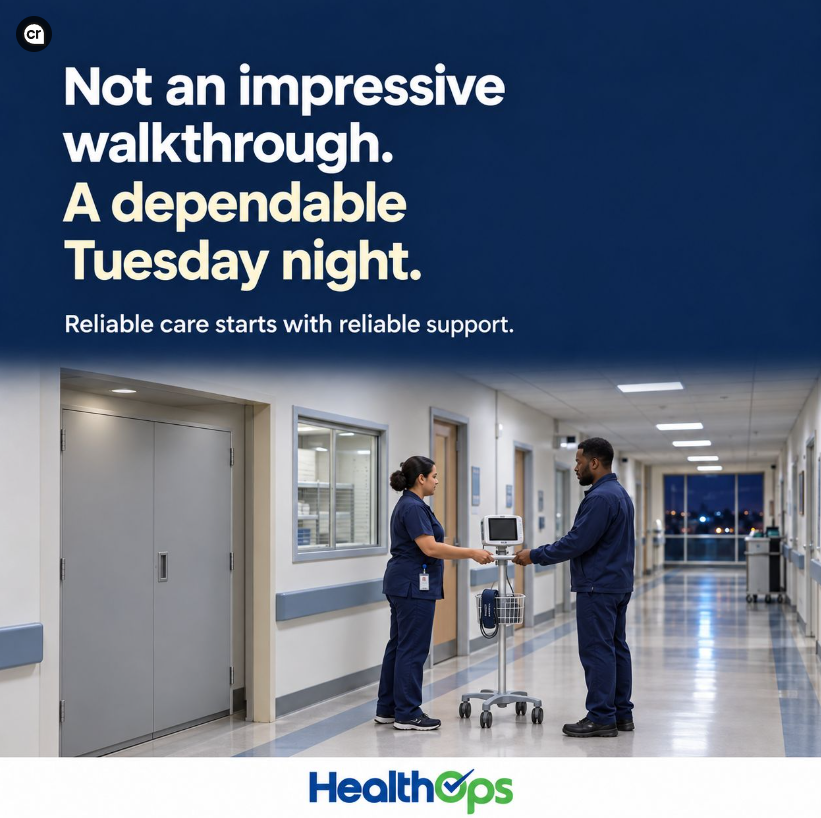
A worker handling off clean equipment to a nurse
About the author:
Isaiah Silva is the founder and president of HealthOps, where he draws on more than two decades of healthcare operations experience to help hospitals streamline support services and improve patient care.