The Reality of Hospital Readiness: Visual Observations from the Floors Across Multiple Hospitals
By Kyle Gibbons, CHS
When healthcare facilities treat "operational efficiency" as a game of rushing frontline staff and setting compliance on autopilot, they aren't managing risk, they are just waiting for the invoice.
Over the past year, my visual observations across multiple hospitals, spanning everything from cleaning routines to hazardous chemical waste infrastructure, revealed a critical paradox. While operational wins like solid frontline hand hygiene and proactive waste sorting were common, the underlying systemic reality was alarming. When leadership treats environmental safety and survey readiness as a "set and forget" task, the entire compliance framework begins to break down.
Here is an analysis of what happens on the floor when accountability breaks down, and how organizations can pivot toward sustainable safety.
The Invisible Danger: Hazardous Spill Kit Failures
Complex clinical environments cannot be managed with generic solutions. Specialized spill readiness assessments frequently exposed gaps that directly threatened staff, families, and patients:
The Disintegrating Defense: In critical areas, personal protective equipment (PPE) inside hazardous spill kits had degraded over time, literally disintegrating upon contact. Furthermore, gloves lacked documentation proving they were chemotherapy-tested, or they carried outdated, handwritten expiration dates.
The Chemotherapy Blind Spot: In oncology and pharmacy spaces, radiological and chemotherapy neutralization agents were frequently missing from spill kits. Without proper neutralizing agents or specialized wipes, a chemo spill could not be properly contained; toxic materials were simply spread across surfaces, exposing everyone in the vicinity.
Outsourced Autopilot: Many facilities contracted laboratory spill kit maintenance to external vendors. However, "outsourced" should not mean "unmonitored." The largest compliance gaps occurred inside laboratories when basic monthly inspection records and quality assurance (QA) checklists were not maintained at the facility level. Using 3rd party vendors to oversee the maintenance of the kits should be reporting conditions to the facility.
Compromised Containment: Bulk 50-gallon containment drums, designed to manage major chemical emergencies near mass storage containers, were too often neglected and found filled with everyday trash or degraded absorbent materials.
The 3-Minute Room Turn: Disinfection Under Pressure
While hazardous waste infrastructure was neglected in some hospitals, other facilities had frontline environmental services (EVS) technicians forced to sprint through clinical spaces. High patient volume created immense pressure to turn rooms over rapidly, leading to systemic, dangerous shortcuts:
The Reused Wipe Crisis: Under extreme time constraints, staff attempted to clean an entire patient environment with a single disinfectant wipe, even rinsing it in a sink to extend its use. Rinsing a chemical wipe completely inactivated the formula, dropping surface disinfection effectiveness to zero.
Inverted Workflows: When speed was prioritized over process, standard operating procedures failed. Technicians cleaned restrooms before damp-wiping patient beds, directly violating "cleanest-to-dirtiest" sequencing and actively cross-contaminating the room.
The "Under & Behind" Illusion: When a room turn was forced into a sub-3-minute window, high dusting was skipped, overbed tables (a primary patient touchpoint) were ignored, and floors directly beneath patient beds were left unswept.
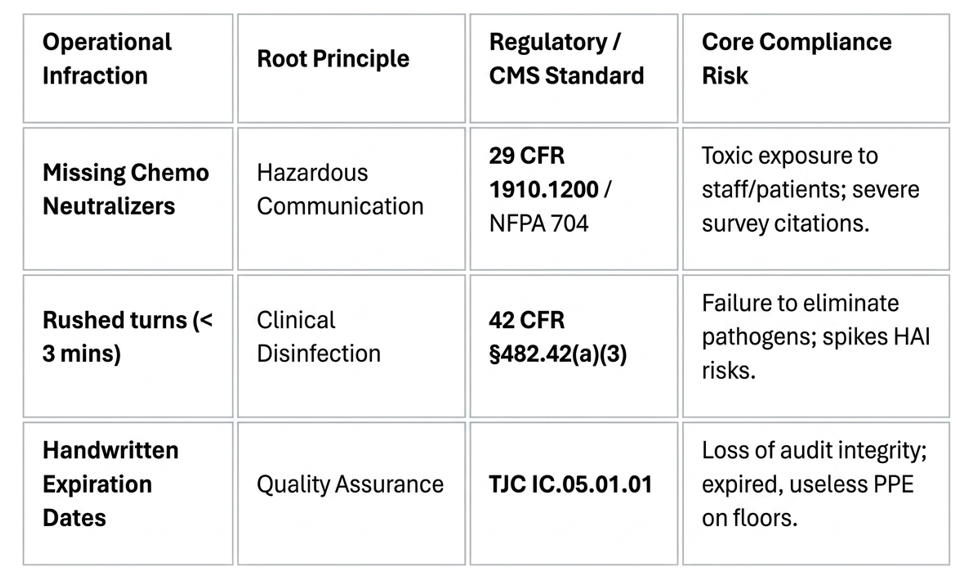
The Regulatory Crosswalk: The True Cost of Non-Compliance
These were not petty, cosmetic issues. These visual observations represent immediate jeopardy risks under federal guidelines and modern accreditation frameworks, such as the Joint Commission Accreditation 360 standards.
When efficiency overrides a basic safety infrastructure, facilities cease to be a secure environment for healing and became a significant regulatory and legal liability.
The Fix: Rebuilding a Culture of Accountability
Fixing a high-pressure operational culture cannot be achieved by handing out generic compliance binders or demanding faster turnaround times. It requires a hard pivot toward evidence-based workforce planning and tech-enhanced tracking.
Ditch the Paper Logs Stop relying on handwritten signatures and static schedules. Move toward digital accountability and automated reporting systems that track assets, lot numbers, and inspection frequencies in real-time.
Enforce the Sequence Protect the integrity of standard operating procedures. Clinical disinfection sequencing (top-to-bottom, cleanest-to-dirtiest) and hazard communication must be treated as non-negotiable safety rules, not operational suggestions.
Audit the Blind Spots True survey readiness means inspecting the areas that are easiest to skip: the undersides of overbed tables, basement chemical storage rooms, and vendor-maintained laboratories
Speed and cost matters in modern healthcare delivery. However, Long-term operational resilience relies on a framework where efficiency and frontline safety coexist.
Organizations need to proactively rebuild these accountability frameworks before regulatory bodies step in.
About the Author
Kyle Gibbons, CHS is a Certified Hospital Surveyor who brings deep healthcare compliance expertise to HealthOps. He specializes in translating complex regulations into clear, practical standards that align policy with everyday clinical and operational practice.