Turning Data into Actionable Insights in Hospital Operations
By Jeffrey Skoog, Operations & Data Analytics Leader and Catherine Krepkikh, DPT, Senior Growth Strategist
Hospitals today have vast amounts of data at their disposal but many lack the processes or skills to organize and analyze that data efficiently. Without a clear strategy and a comprehensive view of their data, facilities often miss key opportunities for optimization, innovation, and revenue.
As HealthOps Data Analytics Assistant Director Jeff Skoog explains, "Imagine taking siloed data from various systems, whether it’s HR, financial, operational, or other business functions, and aligning it to provide a holistic, 360-degree view. By leveraging advanced data integration, cleaning techniques, and powerful analytics tools like Power BI and Python, we help organizations create a data-driven culture that transforms decision-making, at all levels."
The Evolving Role of Data Analytics in Hospitals
Adoption and Impact
Data analytics is now essential in healthcare. The global healthcare data analytics market is projected to reach $94.86 billion by the end of 2025, with hospitals among the leading adopters¹.
Dashboards and real-time analytics are widely used. Hospitals increasingly rely on interactive dashboards to monitor key performance indicators (KPIs), patient flow, and resource utilization, enabling leaders to identify bottlenecks and optimize operations².
AI and predictive analytics are mainstream. About 25% of U.S. hospitals use predictive analytics to improve clinical care and operational effectiveness, and this number is growing rapidly³.
Operational efficiency and patient outcomes are improved. Predictive analytics can reduce hospital operational costs by up to 15% and hospital readmissions by up to 25%, while improving patient satisfaction and resource allocation⁴.
Industry Insights
Cost savings and efficiency: Predictive analytics and dashboards help hospitals reduce unnecessary expenditures, optimize staffing, and improve patient flow, leading to significant cost savings and better patient experiences⁵.
Comprehensive dashboards: Modern hospital dashboards provide real-time tracking of admissions, bed occupancy, financial performance, and resource utilization, supporting data-driven decisions at every level⁶.
AI-driven insights: AI-powered analytics are used for early disease detection, personalized treatment, and operational forecasting, helping hospitals anticipate trends and respond proactively⁷.
Our Process
Every organization’s data needs are different, which is why analytical solutions should be carefully tailored to meet the unique requirements of each client. Each step in a comprehensive Data Cycle should help hospitals accurately transform their raw data into valuable and easy-to-consume insights. Operations Manager Kevin Decristofano created this infographic to highlight HealthOps' essential steps:
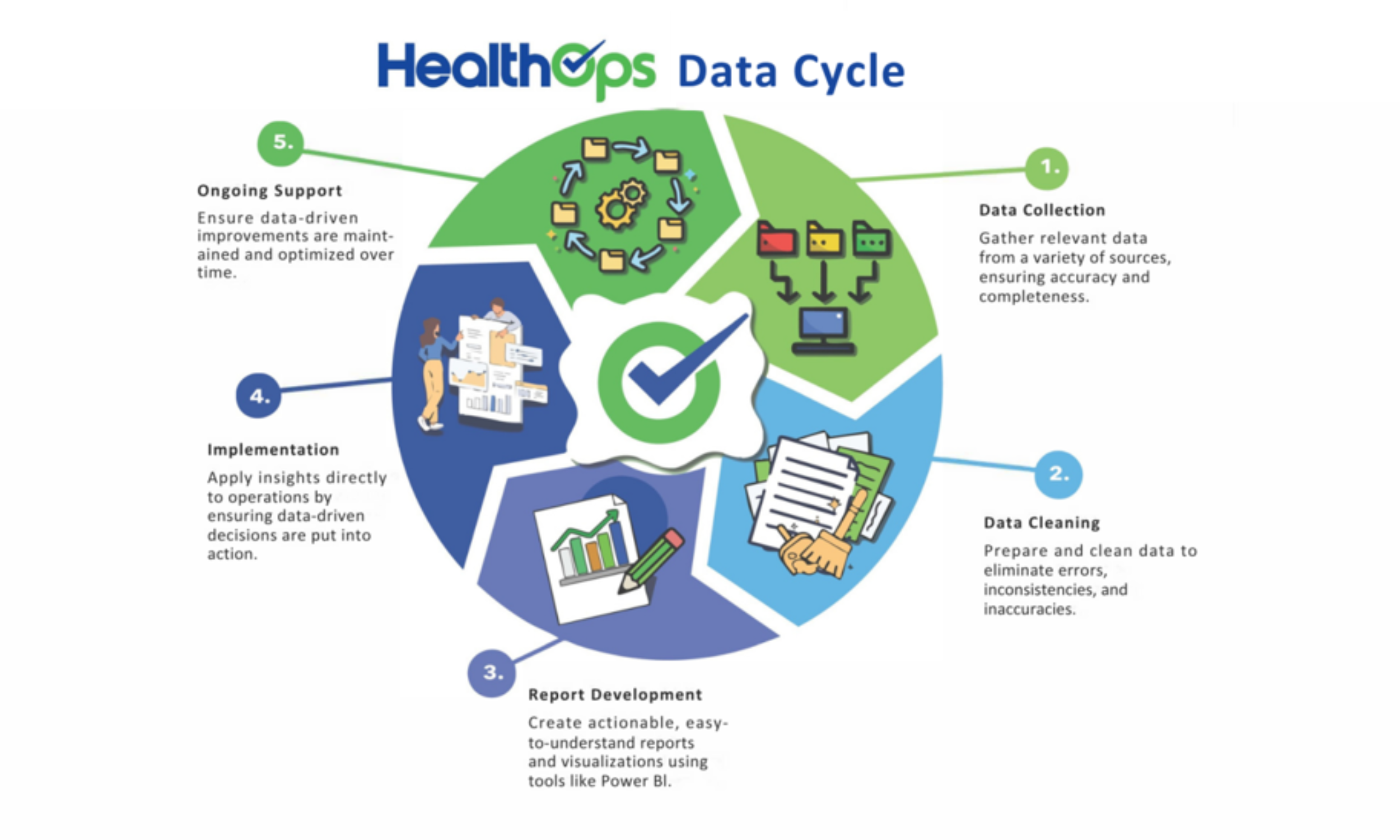
Image created by Kevin Decristofano
Empowering Data-Driven Decision Making
One of the key challenges in healthcare is bridging the gap between data and decision-making. Data is often fragmented or poorly structured, making it difficult for teams to act on insights. By implementing robust data pipelines and analytics frameworks, organizations can build a data-driven decision-making process that empowers leadership, operations, HR, and finance teams to make informed choices.
Operations Analysis: Streamlining workflows and improving resource allocation.
Process Analysis: Identifying inefficiencies and implementing solutions.
Human Resources: Optimizing staffing, improving retention, and increasing satisfaction.
Financial Analysis: Reducing costs, maximizing revenue, and ensuring sustainability.
Regulatory Readiness: Supporting compliance and audit preparation with comprehensive analytics.
Especially for organizations without a full-time Chief Data Officer, CDO-level services fill a crucial gap, providing deep expertise in data strategy, analytics, operations, and governance.
Real-World Impact: From Customer Retention to Operational Forecasting
Data-driven organizations are 23 times more likely to acquire customers, six times as likely to retain them, and 19 times as likely to be profitable⁸.
Hospitals using analytics report improved patient outcomes, reduced costs, and enhanced operational efficiency⁹.
The global big data analytics in healthcare market is expected to grow from $31.46 billion in 2024 to $121.85 billion by 2034, reflecting the sector’s rapid digital transformation¹⁰.
Predictive analytics can reduce hospital operational costs by up to 15% and readmissions by up to 25%⁴.
Hospitals using dashboards and AI-driven analytics report improved patient flow, reduced wait times, and better resource allocation⁶.
Why Hospital Leaders Choose HealthOps Data-Driven Solutions
Healthcare Operations Expertise: Deep understanding of hospital support services ensures analytics are relevant and actionable.
Innovative Technology: Proprietary software and analytics tools enable seamless data integration and real-time reporting.
Dedicated Analytics Team: Access robust statistical expertise without the overhead of a full-time hire.
Scalable Solutions: Platforms are designed to grow with your organization, supporting multi-site operations and evolving needs.
Ready to unlock the full potential of your hospital’s data? Let’s build a data-driven future together: one where every decision is informed, every process is optimized, and every patient benefits from operational excellence.
About the Authors
Catherine Krepkikh DPT, is the Senior Growth Strategist at HealthOps, leading data-driven research and growth while contributing thought leadership in hospital operations, compliance, and strategic outsourcing.
Jeffrey Skoog is the Assistant Director of Data Analytics at HealthOps Inc. He excels at creating innovative data solutions and streamlining processes to drive efficiency and growth.
References
Deloitte. “2025 Global Health Care Outlook.” Deloitte Insights, 11 June 2025, www.deloitte.com/us/en/insights/industry/health-care/life-sciences-and-health-care-industry-outlooks/2025-global-health-care-executive-outlook.html.
International Journal of Innovative Science and Research Technology. “Hospital Dashboard Analytics: Enhancing Healthcare Performance with Data-Driven Insights.” Vol. 10, Issue 3, Mar. 2025, www.ijisrt.com/assets/upload/files/IJISRT25MAR1267.pdf.
Grazitti Interactive. “Transform Healthcare With Predictive Analytics in 2025.” Grazitti, 30 June 2022, www.grazitti.com/blog/improving-healthcare-with-predictive-analytics-2025-and-beyond/.
SuperAGI. “How AI Predictive Analytics is Revolutionizing Healthcare, Retail and Finance in 2025.” SuperAGI, 29 June 2025, superagi.com/how-ai-predictive-analytics-is-revolutionizing-healthcare-retail-and-finance-in-2025/.
CPR Care. “Healthcare Budget Analytics in 2025 Explained.” CPR Care, 14 May 2025, cprcare.com/blog/healthcare-budget-2025/.
Leadsquared. “Healthcare Dashboard: Types, Benefits, And KPIs To Track.” Leadsquared, 16 Apr. 2025, www.leadsquared.com/industries/healthcare/healthcare-dashboard/.
LitsLink. “AI in Healthcare: Breaking Down the 2025 Statistics and Trends.” LitsLink, 26 June 2025, litslink.com/blog/ai-in-healthcare-breaking-down-statistics-and-trends.
McKinsey & Company. “The Age of Analytics: Competing in a Data-Driven World.” McKinsey Global Institute, Dec. 2016, www.mckinsey.com/~/media/mckinsey/business%20functions/mckinsey%20analytics/our%20insights/the%20age%20of%20analytics%20competing%20in%20a%20data%20driven%20world/mgi-the-age-of-analytics-full-report.pdf.
SPD Technology. “The 2025 Guide on Healthcare Data Analytics.” SPD Technology, 19 Mar. 2025, spd.tech/data/healthcare-data-analytics-transforming-patient-care-for-improved-health-outcomes/.
GlobeNewswire. “Big Data in Healthcare Market Research and Forecast Report 2025-2034.” GlobeNewswire, 8 July 2025, finance.yahoo.com/news/big-data-healthcare-market-research-133300020.html.